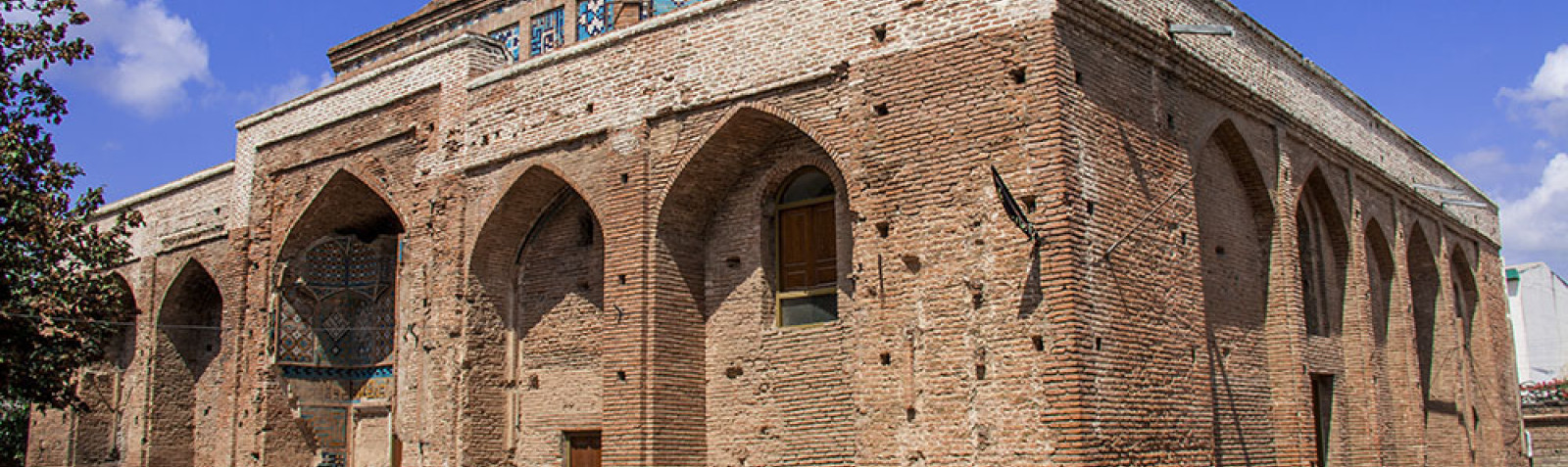
Mir Bozorg Tomb
AmolAmol is a historical city with a history of three thousand years, which was the center of the Amard tribe centuries ago. Later, during the Achaemenid era, it was ruled by satraps, and after the arrival of Arab Muslims in Iran, it became the center of the Alavi rulers. This city also has historical monuments such as Hashtal Tower, Fire Temple, Four Bazaar, and Mir Bozorg Tomb, alongside natural attractions such as forests, mountains, and rivers.
Mir Bozorg Tomb is the tomb of Mir Gholamreza Mara’shi, located in the old neighborhood of Amol in Kardgar neighborhood near Sabzeh Meydan. He was born as one of the descendants of Ali ibn Hussein. He lived in Khorasan for a while, and upon his return to Amol, he created a movement similar to the Sarbedaran uprising, which became known as the Alavi Mara’shi dynasty. He finally passed away in 1402 and was buried in the same place. His tomb was originally a four-room chamber which was rebuilt with the help of people during the reign of Eskandar Sheikh Chalaei, one of the Timurid rulers, between 1411 and 1415.
Due to their interest in the Alavi rulers, the Safavids restored and rebuilt this structure. Based on the order of Shah Abbas I, a larger building with beautiful decorations including tilework and stucco was constructed. Only a few of these tileworks and decorations remain intact, which is not solely due to the neglect of people and officials, but also due to natural wear and tear. The only remaining tilework is decorated with Quranic verses and is located near the dome.
The entrance door of the building is placed in the southern side above of which there is an inscription that reads: “Alhamdulillah wa la ilaha illallah wa Allahu Akbar wa la hawla wala quwwata illa billah”. the name “Mohammad” has been carved slightly upper than the inscription and “bi-smi llāhi r-raḥmāni r-raḥīmi” on the wall. This all-brick building consists of two floors. The first floor has a main space where Mir Gholamreza Mara’shi is buried and there are three rooms around the tomb, and the second floor has two rooms, a hallway, and a staircase leading to the roof. Mir Bozorg's grave is covered with a beautiful wooden box with wooden Gerehs. This box replaced an older one that was destroyed by a fire many years ago, and only the old frame remained on which the year 1032 inscribed.
The dome of this tomb is also newly built. The old dome collapsed, and later architects replaced it with a double-shell dome. The dome is 90 square meters and is octagonal from the inside of the building. After the Islamic Revolution, this building was under the supervision of the Amol Heritage Office for a while and later turned into the Martyrs Museum. The first floor of this building, all walls, and all three rooms are decorated with pictures of martyrs. Letters, books, and clothing of martyrs are other collections of this museum, which is a kind of souvenir of the eight-year Iran-Iraq war.
Mir Bozorg's Tomb in Amol was registered as a national monument on January 5, 1932.